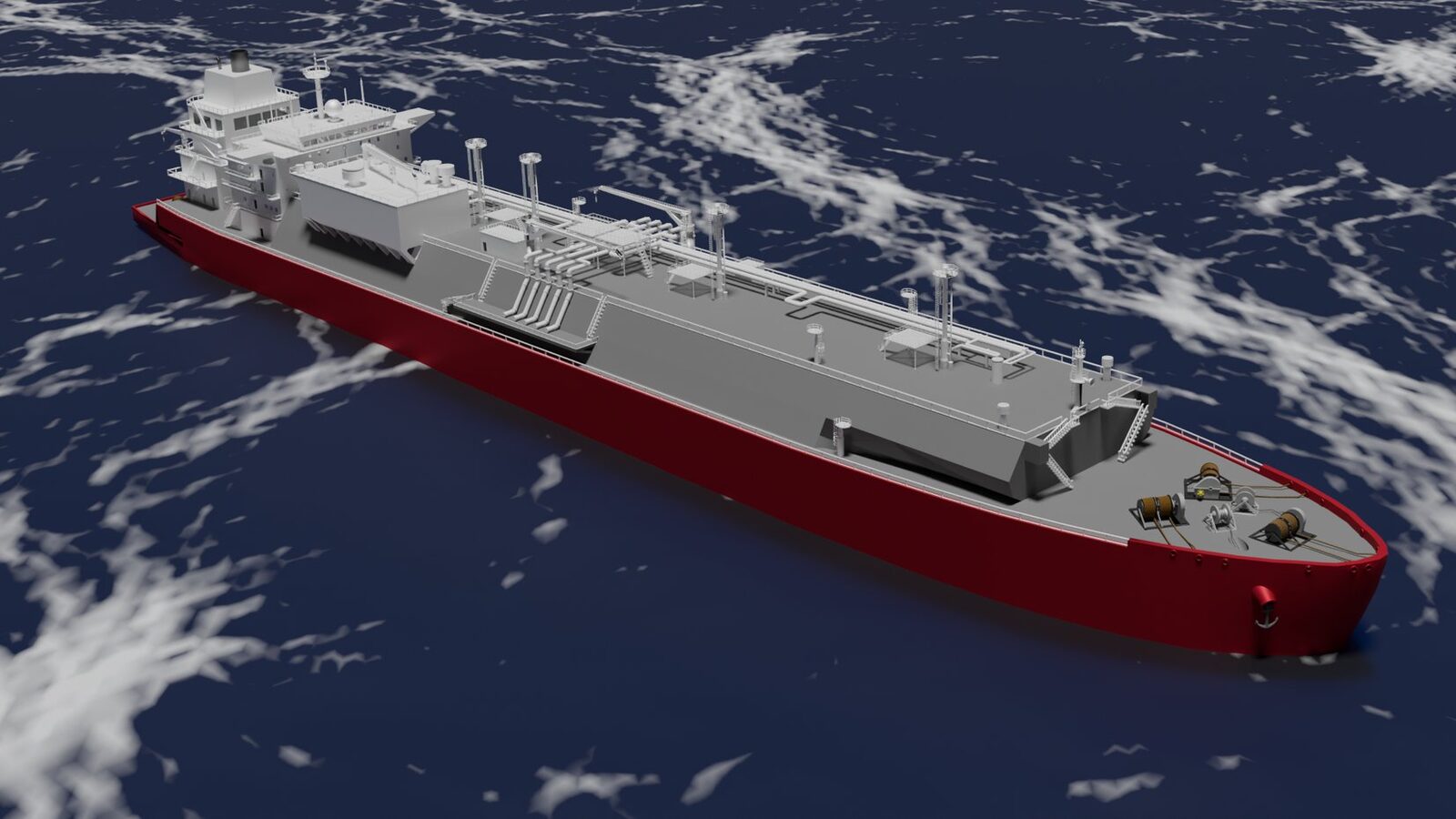
A 3D model of your vessel
Machinery spaces, equipment, instrumentation and controls reproduced to scale from your general arrangement, machinery manuals and operating parameters.
We build bespoke 3D and VR training simulators of your own vessels, with real operating logic. Because the alternative is learning on the machinery itself — and in 2025 the average vessel carried $68,673 in insured damage, most of it machinery, most of it preventable.
Computer-based 3D and VR simulators with real operational logic, built for training. One vessel at a time, from her own documentation — so your crews learn the plant they will actually work on, not a generic engine room.
Machinery spaces, equipment, instrumentation and controls reproduced to scale from your general arrangement, machinery manuals and operating parameters.
Start-up sequences, interlocks, alarms and automatic protections taken from the control philosophy. Procedures have to be followed in order, or nothing runs.
The same build, two ways to run it: on a computer for procedures, briefings and assessment, or in VR for walking the machinery spaces before joining the ship.
Normal operation, emergency drills, and the incidents and near-misses from your own fleet reports rebuilt as exercises. The model is updated as the ship changes.
Scope is set per vessel — from a single machinery space to every plant on board — so there is no list price. Tell us the ship and what your crews need to practise, and we come back with a costed proposal.
Get in touch for a custom offerWe start from the vessel's own plans, machinery manuals and operating parameters, and rebuild not just the geometry but the behaviour: pressure and temperature limits, start-up sequences, failure response.
Engines will not start without starting air and pre-heating. Lines must be set correctly before anything moves. If a simulator lets you cheat, it teaches nothing.
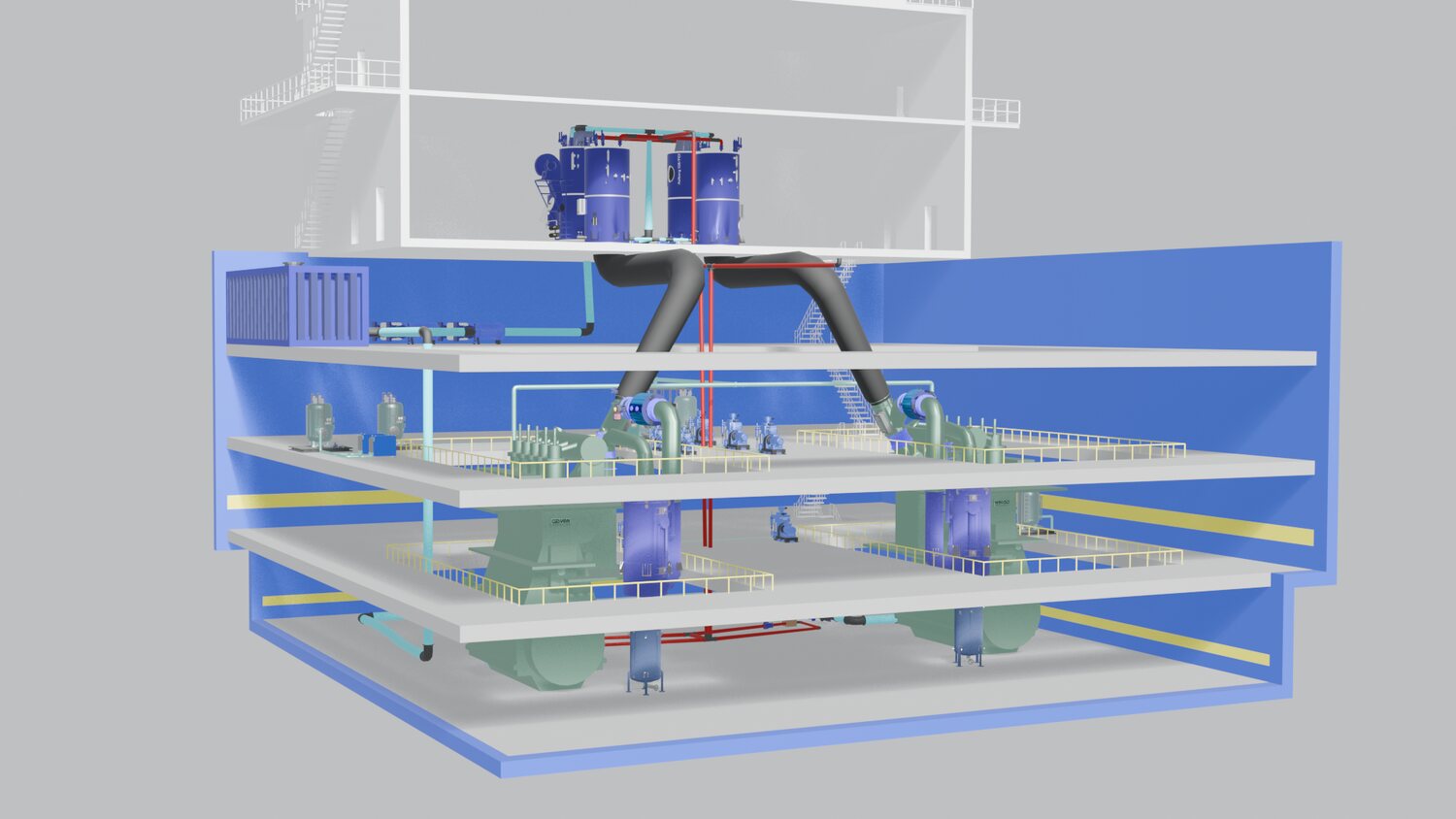
Hull, engine room and equipment rebuilt from the general arrangement and machinery manuals — never a generic stand-in.
Propulsion, compressed air and boilers run as one plant, with interlocks, alarms and automatic protections that behave like the real thing.
Runs on standard computers and consumer headsets. No simulator cabinet, no dedicated training room, no installation capital — we confirm the specification you need before you commit.
Our reference build is a complete dual-fuel LNG carrier, rebuilt from her own documentation. Everything below was recorded straight out of the simulator — no edits to the instrumentation, no staged panels.
Scope is set per vessel, not per package. If a system exists on board and matters to your crews, it can be in the simulator — from a single machinery space to every plant on the ship.
Propulsion, compressed air, steam and boilers today — cargo, fuel, cooling, electrical or firefighting when you need them. They run as one plant, with the dependencies between them intact.
Every panel is synchronised with the running model in real time — no static screenshots, no scripted sequences. Readings move because the plant moved.
Start-ups, changeovers and departures, plus the failures that actually hurt your fleet: your own incidents and near-misses, rebuilt as drills that can be repeated until the response is automatic.
The alarm matrix and the safety logic behind it, reproduced from the control philosophy — including the interlocks that refuse an unsafe command and log why.
Standard computers for the desktop build; consumer headsets for VR, currently PC-tethered and requiring a dedicated graphics card. No console, no dedicated training room, no travel, no installation capital.
These are not our figures. They come from the Nordic Association of Marine Insurers (Cefor), whose Ocean Hull statistics cover roughly a third of the world merchant fleet, and from Allianz's annual safety review. Read together, they say something uncomfortable: the damage bill is rising, machinery is the single largest cause, and the dominant root cause is human.
Ocean hull & machinery claims, all vessels in the Cefor portfolio, USD, by accident year.
Share of total claim cost by type of casualty, 2025.
Machinery also accounts for 47% of the number of all claims — the most frequent casualty on board, and the one closest to how the plant is operated.
Share of insured vessels suffering a machinery claim above USD 500,000, per year.
The average claim above USD 10,000 now costs $600,062 — up from $405,647 in 2016. Bigger machinery, tighter schedules, thinner margins for error.
A ship-specific simulator does not remove risk. It moves the first mistake off the machinery and into a build where it costs nothing but a restart.
What a build costs depends on the vessel and how much of her you want simulated. We scope it with you first, then quote — and the figure covers the licence, the scenarios and support for its duration.
Get in touch for a custom offerFigures are industry-wide averages published by the organisations above; they describe the sector, not results measured on our product. Cefor statistics reflect the Nordic portfolio and are reproduced with credit as required by the publisher.
We start small and measurable, then scale. Every phase ends in something you can open and try yourself — no six-month silence followed by one big handover.
Together we pick a representative ship. We start from her plans, machinery manuals and operating parameters, agree which systems and scenarios matter most, and model the engine room and key equipment to scale in Blender — laid out as they are on board. Staged delivery, with a demo at every step.
Pressure and temperature limits, start-up sequences, lead-lag pump control, alarms and interlocks — written in Unity and C#, then verified by marine electromechanical engineers against the vessel's own control philosophy. This is the part that decides whether a simulator teaches anything.
Desktop and VR builds delivered with the scenario library. Sister vessels then reuse the platform and models — substantially lower cost and delivery time for every added ship — so we progressively cover all types in your fleet.
Incidents and near-misses from your fleet reports become new training scenarios. The ship changes — the model is updated with her. Per-vessel licence with support included: no simulator console, no dedicated training room, no hidden costs — budgetable as a service rather than a capital investment.
It depends on how much of the ship you want simulated, and we scope it together before anything starts. Delivery is staged — you see a working build at every milestone rather than waiting for one big handover at the end.
The vessel's general arrangement, machinery manuals and operating parameters — plus a conversation about the incidents and near-misses you would like turned into drills. Everything we receive stays confidential and is used only for your build.
No simulator console and no dedicated training room — that is the six-figure capital cost you avoid, and it is the honest headline. What you do need is ordinary computing. The desktop build runs on standard Windows computers, and we confirm the minimum specification against the machines your crews actually use before you commit to anything. The VR build is currently PC-tethered, so it needs a headset plus a computer with a dedicated graphics card. We tell you exactly what is required during scoping, not afterwards.
No — and we will not pretend otherwise. Our simulators are ship-specific familiarization and drill tools for your own crews. They complement certified training rather than substituting for it, and we are open about that in every conversation.
Sister vessels reuse the platform and much of the modelling, so every ship after the first costs substantially less and arrives faster. Scenarios and vessel modifications are updated throughout the licence.
Borders? I have never seen one. But I have heard they exist in the minds of some people.Thor Heyerdahl
Where we come from, what has been assessed formally, and what the people who have seen the simulator make of it.
The reference build was submitted as our diploma project at the "Mircea cel Bătrân" Naval Academy in Constanța and awarded the maximum grade.
Developed under the supervision of Assoc. Prof. Florin Postolache, PhD, Faculty of Marine Engineering.
The propulsion plant study behind the simulator was presented at the academy's scientific session.
Two written assessments from people who examined the simulator and questioned us about it — one from a naval engineering company we have worked alongside, one from a simulation specialist at a major marine technology group. Both are reproduced from the signed letters.
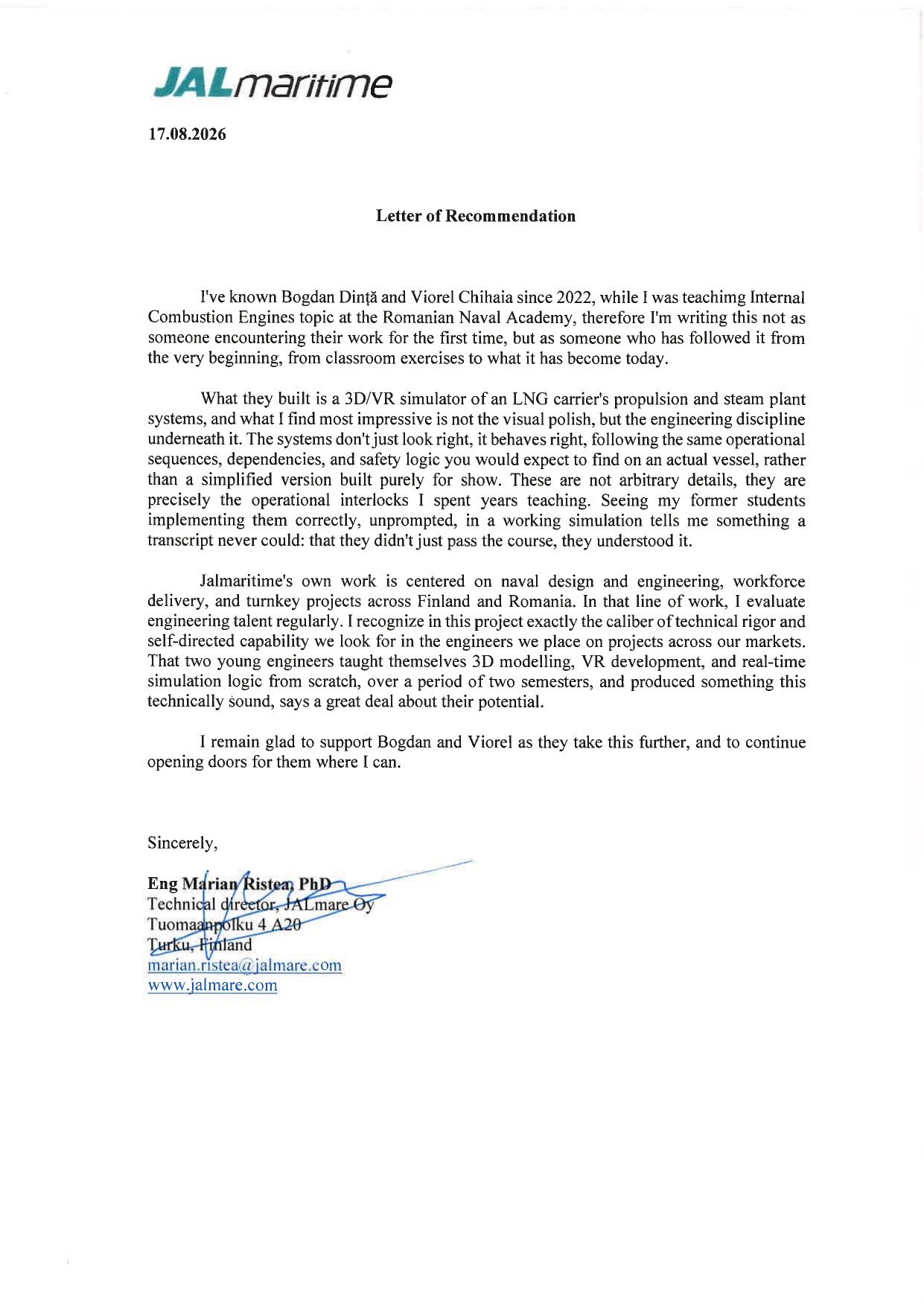 Open full letter (PDF)
“The systems don't just look right, it behaves right — following the same operational sequences, dependencies, and safety logic you would expect to find on an actual vessel. These are precisely the operational interlocks I spent years teaching.”
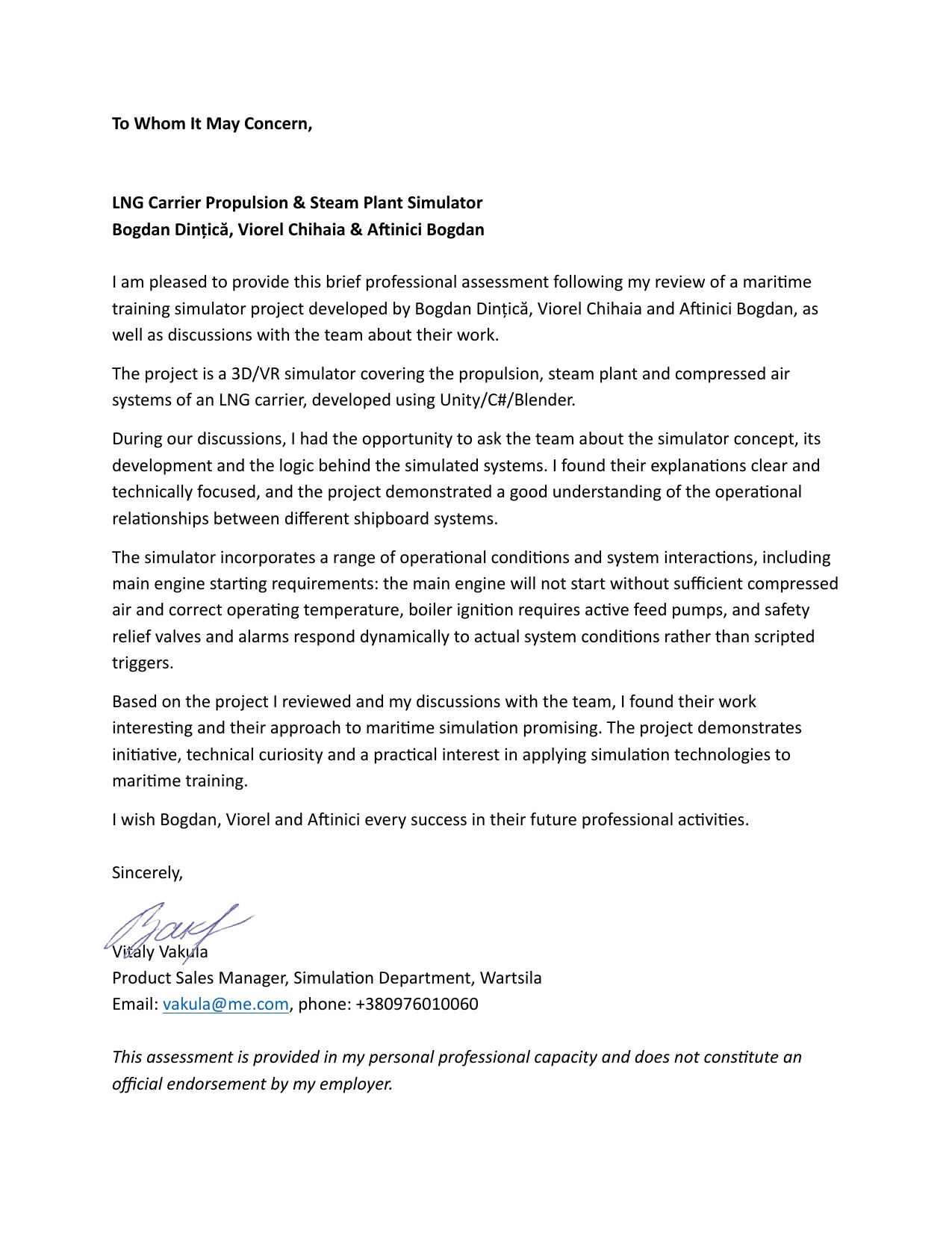 Open full letter (PDF)
“The main engine will not start without sufficient compressed air and correct operating temperature, boiler ignition requires active feed pumps, and safety relief valves and alarms respond dynamically to actual system conditions rather than scripted triggers.”
Your name here
—
after the first build
Reserved for
a fleet or training manager
The full technical case study — thesis, videos and gallery — is public, and a live demo takes 30 minutes.
No sales team in between. You speak directly to the people who model the vessels and write the simulation logic.